If you spent Chuseok in Korea this year, you probably ate more than you meant to. If you were somewhere far away, hopefully you still managed to eat some good food and get a little bit of that holiday feeling. Either way, 추석 is one of those words that comes up constantly this time of year, along with a handful of others that don't translate cleanly into English. So today, let's go through the Korean words you'll hear during Chuseok season, and what's really behind them.
추석 — more than just "Korean Thanksgiving"
The easiest way to explain 추석 to someone unfamiliar with it is "Korean Thanksgiving" or "the Korean harvest festival." Both get the basic idea across: it’s a holiday centered on gratitude for the harvest and family gathering. But 추석 runs on the lunar calendar, so the date shifts every year on the solar calendar, unlike the fixed date of Thanksgiving in the US.
"추석은 음력 8월 15일이에요." — 추석 falls on the 15th day of the 8th lunar month.
"그래서 매년 날짜가 달라져요." — That's why the date changes every year.
한가위 — the older, more poetic name for 추석
한가위 and 추석 refer to the exact same holiday, but 한가위 is the native Korean name, while 추석 comes from Chinese characters meaning "autumn evening." 한가위 breaks down into 한 (big, or great) and 가위 (an old word for the middle of something), so the name itself basically means "the big middle of autumn." You'll hear it most in the phrase 한가위만 같아라, a saying wishing that every day could be as abundant as Chuseok.
"한가위만 같아라 라는 말 들어봤어요?" — Have you heard the phrase "may every day be like 한가위"?
"그만큼 풍성한 명절이라는 뜻이에요." — It means that's how abundant this holiday is supposed to feel.
차례 — the morning ritual
차례, if translated to English, is closest to "ancestral rites" or "a memorial service for one's ancestors." Families gather in the morning, set out food, and perform 차례 to honor the ancestors before the rest of the day's eating and visiting begins. That said, 차례 isn't a given anymore. Plenty of families these days skip it entirely, whether for religious reasons, distance, or just not seeing the point in keeping it up, and instead spend the morning just eating and relaxing together.
"우리 가족은 아침 일찍 모여서 차례를 지내요." — My family gathers early in the morning to perform 차례.
"할머니가 며칠 전부터 차례 음식을 준비하셨어요." — My grandmother had been preparing the food for 차례 for days.

성묘 — visiting the graves afterward
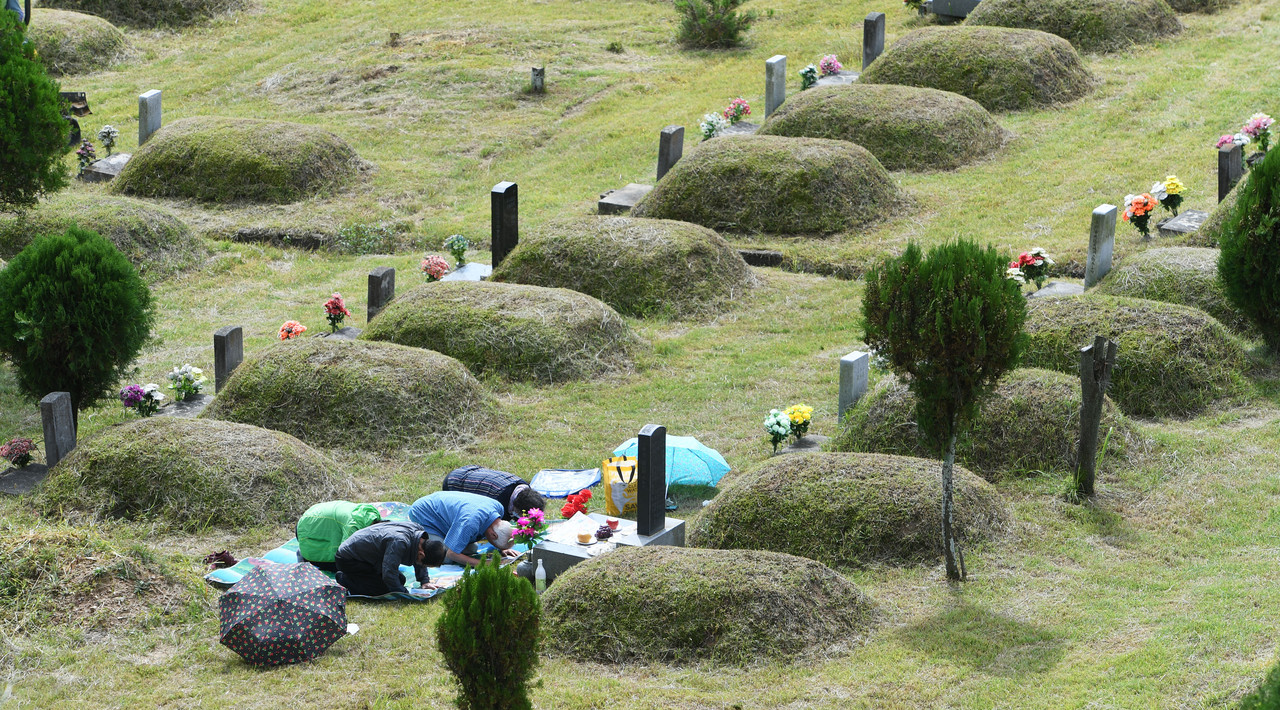
Once 차례 is done, a lot of families head out for 성묘, visiting and tidying up ancestral graves. It usually involves pulling weeds, laying out a small offering, and giving a quick bow. Some families do a related task called 벌초 — cutting back the overgrown grass around a grave — separately, often a few weeks before Chuseok itself, so the grave looks presentable by the time everyone visits.
"이번 주말에 성묘 가기로 했어요." — We decided to go do 성묘 this weekend.
"아버지가 벌초는 미리 해두셨어요." — My dad already did the 벌초 beforehand.
송편 — not just "rice cake"
송편 is the rice cake made specifically for Chuseok and you won't see it around at other holidays. The shape is a half-moon, folded closed around a filling of sweet sesame seeds, beans, or chestnuts. There's even an old belief that whoever shapes the prettiest 송편 will meet a good spouse or have a beautiful daughter.
"우리는 추석 전날 다 같이 송편을 빚었어요." — We made 송편 together as a family the night before 추석.
"속에 뭐가 들었는지에 따라 맛이 완전히 달라져요." — The taste changes completely depending on what's inside.
귀성길 — the yearly traffic everyone complains about
No Chuseok conversation is complete without someone mentioning 귀성길, the journey back to one's hometown. It's less a single word and more a whole seasonal event where millions of people leave the cities at once, all headed the same direction, all stuck in the same traffic. If everyone lives close to one another, this is a huge relief as the traffic can make commute times more than double!
"귀성길에 평소보다 두 배는 걸렸어요." — The trip home took twice as long as usual because of 귀성길.
"고속도로가 꽉 막혀서 다들 고생했대요." — Everyone had a rough time because the highways were completely jammed.