Korean Drinking Culture (술 문화)
If you walk along some Seoul streets, odds are you’ll see plenty of cozy looking spots for a drink with bustling activity inside. They can look like tents on the sidewalk, high-class wine bars, or college bars. They got everything!
Today we’re going to chat about drinking culture in Korea, talk about the various spots to grab a drink and what to potentially order there!
Also, if you don’t drink, no worries! Non-alcoholic beers are getting more and more popular over there, and NA wine is starting to enter the market as well. Whether some of these places carry it, that might be hit or miss, but worth a shot!
Where to Drink? (어디서 마실까?)
The place you’re drinking tends to set the vibe of the kind of drinks you’ll be having. Korea has a variety of different places to grab a drink. Let’s look at some!
| Korean Word | Breakdown | Description |
술집 | 술 (liquor/alcohol) + 집 (house) | The general, catch-all term for any drinking establishment, essentially a bar or pub. |
포장마차 (or 포차) | 포장 (canopy/cover) + 마차 (carriage/coach) | Historically a covered wagon, it is now a covered street tent or casual indoor venue. Known for comfort food and a uniquely nostalgic atmosphere. |
와인바 | 와인 (Wine) + 바 (Bar) | A modern, often upscale or cozy spot focusing on wine, differentiating itself from the traditional soju-centric venues. |
다이닝바 | 다이닝 (Dining) + 바 (Bar) | A bar that places an equal or greater emphasis on its high-quality food (dining) compared to its drink selection, offering a more gourmet experience. |
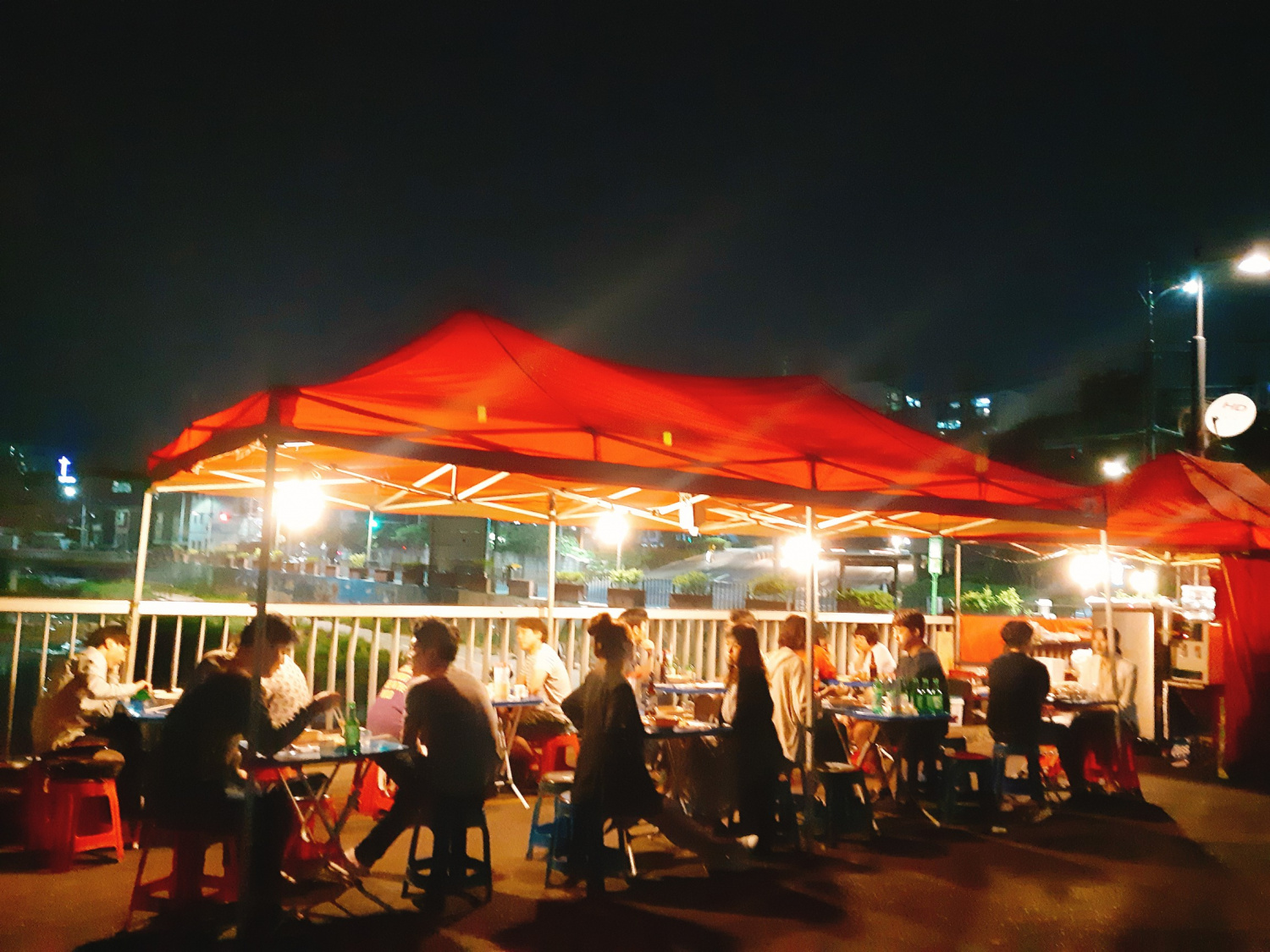 A classic포장마차 on a cool night...
What to Drink? (무엇을 마실까?)
While Western imports like 와인are common, the heart of Korean drinking culture lies in its traditional spirits and their combos.
Korean Word | Breakdown | Description |
소주 | 소 (燒, "to burn") + 주 (酒, "alcoholic drink") | "Burned liquor," referring to the distillation process. It is a clear, low-cost distilled spirit, traditionally made from rice, and is the most popular liquor in Korea. |
맥주 | 맥 (麥, "barley/grain") + 주 (酒, "alcoholic drink") | "Barley liquor." This is the Korean word for beer, with lagers from major brands being the most common type. |
소맥 | 소 (from 소주) + 맥 (from 맥주) | A portmanteau for the classic blend of Soju and Beer. Makes Soju more drinkable, and Beer stronger - perfect combo! |
막걸리 | 막 (carelessly/just now) + 걸리다 (to filter) | "Just coarsely filtered liquor." It is a cloudy, lightly carbonated rice wine known for its sweet and tangy flavor. |
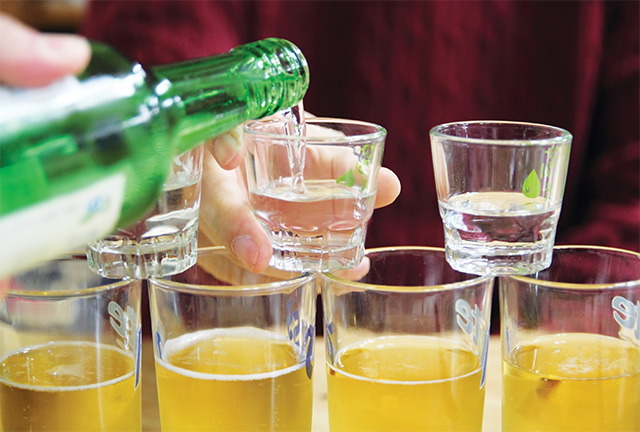 One of the fun ways to make 소맥
Drink to Eat? Eat to Drink?
The Korean philosophy on drinking is that it must always be accompanied by food—this food is called 안주.
안 (按, "to press down/suppress") + 주 (酒, "alcoholic drink")
The term literally means "food to suppress the alcohol." 안주 is considered a mandatory accompaniment to alcohol, helping to slow absorption and prevent intoxication (but also because it's delicious)
Some Typical Combos
In Korea, certain drinks are practically inseparable from their food partners. In Korean, these are total 꿀조합 (perfect combo! check out our post on Korean food slang):
치킨 + 맥주 = 치맥: The everyday combo. The crispy Korean Fried Chicken pairs perfectly with a cold, refreshing glass of beer.
소주 + 삼겹살: The staple pairing. The intensely charred, fatty, and savory pork belly is perfectly cut by the clean, sharp burn of chilled 소주.
막걸리 + 파전: The "Rainy Day" pairing. The savory seafood or vegetable pancake (파전) is often cooked during a rainfall, and its light texture and oiliness complement the earthy, slightly effervescent flavor of 막걸리.
Drinking Games (술 게임)
Ahh, the excuses we use to drink (perhaps too much) and learn about our friends (perhaps too much). The types of games played can often signal the age or social context of the group.. so we won’t reveal our favorite games 😜
Korean drinking game starts with a fun intro, as you’ve probably already heard from the famous 아파트 by Rosé and Bruno Mars. It starts with chanting like "~가~ 좋아하는~ 랜덤~ 게임~" (Random~ Game~ (someone)~ likes~). This is chanted before any of the following games, usually.
아파트 (Apartment) Game
The most famous Korean drinking game of all.
The Rules: Players chant "아파트, 아파트" in rhythm, then a leader calls out a number (a "floor"). Players stack their hands and, on the count, one person removes their hand from the bottom of the stack and places it on top. The person whose hand is placed on top of the stack when the count reaches the called number loses and drinks.
손병호 게임 (Son Byung Ho Game)
This is the Korean version of "Never Have I Ever," named after the actor who popularized it on a Korean TV show. It was previously known as the “Five Fingers Game”.
The Rules: Everyone starts with an agreed number of fingers up (usually five or ten). One player says something they have done (or the classic 'Never Have I Ever' is also used, where you say something you haven't done). Anyone who fits the description must fold one finger. The first person to fold all their fingers loses and drinks.
베스킨라빈스 31 (Baskin Robbins 31)
Yes. That Baskin Robbins. Named after the ice cream chain famous for its 31 flavors (probably has a lot more than 31, though).
The Rules: Players go in a circle, counting numbers starting from one. On their turn, a player can say 1, 2, or 3 consecutive numbers. The person who is forced to say the number 31 is the loser and must drink.
Drinking with an Older Person?
If you happen to be drinking with older people, there are a few social nuances that you should know (unless they’re super chill and already playing 베스킨라빈스 31 with you):
Receiving a Drink: Always receive your glass with both hands as a sign of respect.
Pouring a Drink: When pouring for an elder, hold the bottle with your dominant hand and gently support your wrist or forearm with your other hand. Pay close attention to their shots, offer them to refill their drink when they are empty. Never pour your own drink.
Turning Away: When taking a drink in front of an elder, you must turn your back or turn your head and body away, covering your mouth and glass with your hands, and then drink. This is a sign of modesty and respect, as it prevents them from seeing you drink.
Bit of a history on these manners!
One of the 6 core rituals of Confucianism is 향음주례 or Local Drinking Ritual where it would reinforce Confucian values within the community. In this ritual, they would teach manners on how to pour, receive, and drink. So, these rituals go way back! Like thousands of years back!
Usually, if you are drinking beer, it tendsto be more casual, so these rules aren’t quite as strict. But at company team dinners (회식) or if you’re meeting your partner’s family, it’s generally safer to use these norms unless they start chanting "~가~ 좋아하는~ 랜덤~ 게임~" 😂
건배! 짠! 🍻🥂