If you’re driving around Korea, like any country, there are a bountiful amount of signs. While GPS can get you pretty much 95% of the way there, knowing the other 5% can save you getting towed or ticketed when driving around.
So, we’re gonna cover common signs you’ll see when driving and what they mean so that you can avoid paying unnecessary fines!
Directional Signs
직진 means go straight — 직 (straight) + 진 (advance).
좌회전 is left turn — 좌 (left) + 회전 (turn).
우회전 is right turn — 우 (right) + 회전 (turn).
And 유턴 is, well, U-turn.
You'll also see 출구 for exit — 출 (out) + 구 (opening) — and 입구 for entrance — 입 (in) + 구 (opening). Super common in parking garages and highway ramps.
On highways, you'll notice signs that say something like 제주시방면 or 서울방향. The key words here are 방면 — 방 (direction) + 면 (side) — and 방향 — 방 (direction) + 향 (facing) — which both mean "toward" or "in the direction of." And 전방 just means "ahead" — 전 (front) + 방 (direction). You'll see it paired with warnings like 전방 공사중 (construction ahead).
Speed & Traffic Control
정지 is stop — 정 (still) + 지 (stop).
서행 means slow down — 서 (slow) + 행 (travel).
You'll sometimes see the polite version 서행하세요 on neighborhood signs. 감속 means reduce speed — 감 (reduce) + 속 (speed).
진입금지 means no entry — 진입 (entering) + 금지 (prohibited).
일방통행 is one way — 일방 (one direction) + 통행 (passage). If you see either of these and keep going, you're gonna have a bad time.
One Korea-specific thing to know about: 구간단속 — 구간 (section) + 단속 (enforcement) — or average speed enforcement zones. Unlike a regular speed camera that clocks you at one point, these measure your average speed between two cameras. So slowing down right before the camera and speeding back up doesn't work. Your navigation app (Kakao Navi or T Map or Naver Map) will warn you about these, so make sure you're using one.
Warning Signs
Here's a nice shortcut: 주의 means "caution." Once you know that one word, you can decode a ton of warning signs even if you've never seen them before.
낙석주의 — 낙석 (falling rocks) + 주의 (caution). 미끄럼주의 — 미끄럼 (slipping) + 주의 (caution). 안개주의 — 안개 (fog) + 주의 (caution). See the pattern?
Other warnings you'll run into: 공사중 means under construction — 공사 (construction) + 중 (in progress). 어린이보호구역 is a school zone — 어린이 (children) + 보호 (protection) + 구역 (zone). These are strictly enforced with lower speed limits and hefty fines for violations. And 과속방지턱 is a speed bump — 과속 (speeding) + 방지 (prevention) + 턱 (bump).
Parking
Alright, this is the part that'll actually save your wallet. Parking violations are the easiest way to rack up fines if you don't know what to look for.
The two big signs:
- 주차금지 means no parking — 주차 (parking) + 금지 (prohibited).
- 주정차금지 means no parking AND no stopping — 주정차 (parking and stopping) + 금지 (prohibited) — not even for a quick drop-off.
If you see 견인지역, that's a tow-away zone — 견인 (towing) + 지역 (area) — and they absolutely will tow you.
Other parking signs you'll see: 거주자우선주차 is resident priority parking — 거주자 (resident) + 우선 (priority) + 주차 (parking). Don't park there unless you're registered for that spot. 장애인전용주차 is handicapped parking only — 장애인 (disabled person) + 전용 (exclusive use) + 주차 (parking) — and the fine for parking there without a permit is around ₩100,000.
The Curb Color System
Korea uses colored curb lines to tell you what's allowed:
- A solid yellow line means no parking and no stopping.
- A dashed yellow line means you can stop briefly (dropping someone off, quick loading) but can't park.
- White lines are legal parking spots.
- Blue lines are reserved for handicapped parking.
Highway & Infrastructure Signs
고속도로 is expressway — 고속 (high speed) + 도로 (road).
휴게소 is a rest area — 휴게 (rest) + 소 (place).
Korea's highway rest stops are honestly great, by the way, with solid food options (호두과자 vs. 델리만쥬… that’s always the question), clean facilities, and sometimes batting cages? No joke, I was surprised when I first saw them, but they are a blast and a good way to kill some time.

졸음쉼터 is a drowsy driver rest stop — 졸음 (drowsiness) + 쉼터 (resting place).
주유소 is a gas station — 주유 (fueling) + 소 (place).
충전소 is a charging station — 충전 (charging) + 소 (place).
And 톨게이트 is a toll gate — though if you have a 하이패스 terminal, you can blow right through the dedicated lane.
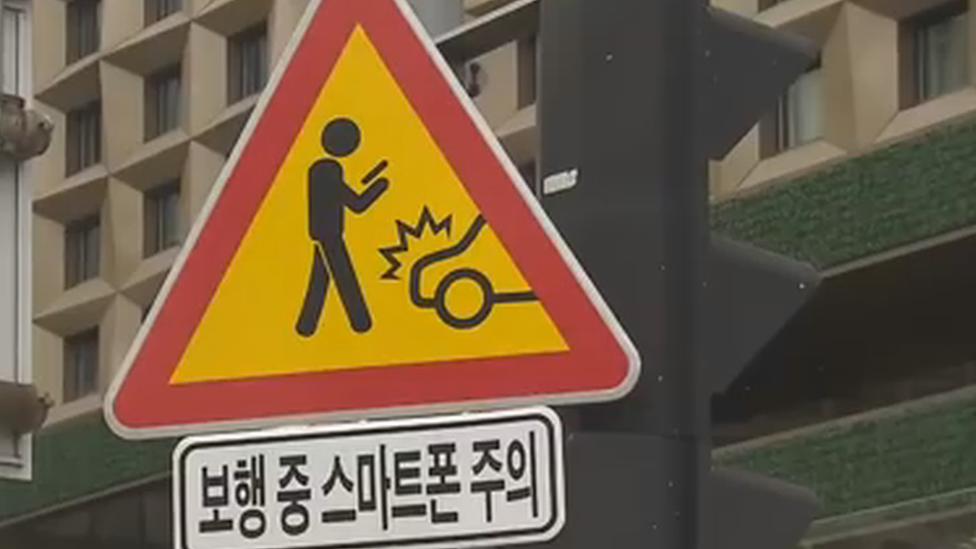
There are even signs for you to be careful on your phone now!